AI Detector Gram

AI Detector Gram — independent reviews, comparisons, pricing and step-by-step guides on Aizhi.

  • CatDV

    CatDV

    CatDV is a media asset manager program for handling multimedia production workflows developed by Square Box Systems. Quantum Corporation acquired Square Box Systems in 2020. == Versions == The full family of CatDV Products is as follows: CatDV Standalone Products CatDV Professional Edition CatDV Pegasus CatDV Networked Products CatDV Essential - entry level server product CatDV Enterprise Server - for MySQL databases and most common server platforms including Linux, Windows and Mac OS X CatDV Pegasus Server - adds features such as high performance full-text indexing, access control lists, and more CatDV Worker Node - automated workflow and transcoding engine CatDV Web Client - provides access to the CatDV database via a web browser. There is no need to install special software on the desktop, making it easy to deploy to a large number of users. CatDV Professional Edition & Pegasus Clients - designed to support the multi-user capabilities of the CatDV Enterprise and Workgroup Servers from the desktop Using plugins and scripting, which often require additional professional services support to set up, complex integrations with a wide variety of third party systems (including archive, cloud storage, and artificial intelligence) are possible. == Awards == CatDV won two awards in 2010, a blue ribbon from Creative COW Magazine and a "Best of Show Vidy Award" from Videography. In April 2012 Square Box won a Queen's Award for Enterprise for CatDV.

    Read more →
  • AppBlock

    AppBlock

    AppBlock is a software tool for managing screen time that limits access to selected mobile applications and websites. Developed by the Czech studio MobileSoft, it is distributed for Android and iOS devices as well as through browser extensions for Google Chrome, Microsoft Edge and Brave, and as desktop solutions. The application is used primarily to restrict time spent on social media and similar distracting services while working and studying. By 2025, the application reported 700,000 monthly active users, with the domestic Czech market accounting for less than one percent of its total user base and revenue. == History == === Origins === AppBlock was created by the Czech software studio MobileSoft, based in Hradec Králové. The studio was founded in 2012 by Miroslav Novosvětský, who remains the sole owner. The idea for the application arose from the use of browser-based website blockers on desktop computers. AppBlock was conceived as a way to reduce the time spent on mobile devices. === Early releases === In its early phase, AppBlock was available only for phones running on Android. Early versions allowed users to limit access to selected applications and websites during specified periods. From the outset, the application was distributed internationally rather than only within the Czech market, and early coverage reported a multi-million number of downloads worldwide. === Expansion of functionality === Over time, AppBlock has expanded beyond basic application blocking to include additional functions related to limiting procrastination and managing attention. The development of AppBlock accelerated during the COVID-19 pandemic. Following a reduction in external client orders, the studio reallocated resources from contract development to the application. Increased digital content consumption during lockdowns contributed to a rise in the application's usage and revenue. As the application developed, it became the company's product with the largest user base. Novosvětský described an increase in downloads over a twelve-month period, which he linked in part to the company's activities abroad, including participation in events focused on mobile marketing in the United States. These activities were an important factor in the further development of AppBlock. === Internationalization and market expansion === Within roughly the first eight years of the company's existence, MobileSoft became active both in the domestic Czech market and in the United States, supported among other things by participation in the CzechAccelerator program, which is intended to help Czech firms enter foreign markets. In mid-August 2021 the developers launched a version for iOS, which soon began to attract paying users. The expansion to iOS was accompanied by plans for cooperation with the Procrastination.com platform, intended to complement the blocking functions with educational content related to digital media use, sleep and work habits. By 2025, AppBlock was localised into 15 languages, with the largest share of users in the United States, the United Kingdom, Germany, and France, with recent growth in Brazil, and usage extending across several continents. AppBlock has reached more than 10 million installations. In the same period its creators announced plans to refine existing functions and to expand support beyond mobile phones to desktop use, including through support for additional web browsers. == Features == === Supported platforms === AppBlock is distributed as a mobile application for Android and iOS users through Google Play and the Apple App Store. Browser extensions for desktop systems are available for Google Chrome, Microsoft Edge and Brave. === Functionality === AppBlock's core function is to restrict access to selected applications and websites. The mobile application shows a list of installed apps and lets the user select which ones to block. It also includes tools to block specific websites and, on iOS, to block certain phrases entered in the Safari browser. AppBlock can mute notifications from selected applications, so alerts from those apps do not appear while blocking is active. In addition to choosing which apps or content to block, the software also offers an allowlist mode, where only selected applications remain accessible and all others are blocked. Blocking rules are organized into configurable schedules, called profiles. Users can create profiles that define time periods when selected apps and websites are unavailable. Newer versions also allow profiles to be activated automatically based on the time of day, days of the week, the device's location, or connection to specific Wi-Fi networks. The iOS version lets users set limits on how often or how long certain apps can be used before they are blocked, and it can track and restrict screen time for individual apps. In addition to these recurring rules, AppBlock includes a Quick Block feature that temporarily blocks selected apps and websites with a single action, without requiring a separate long-term schedule. Strict Mode is an optional setting that limits the ability to change blocking once it is active. For a specified period, it prevents editing AppBlock's rules and can be configured to stop the app from being uninstalled during that time. While Strict Mode is enabled, users cannot modify or disable the restrictions they have set. Deactivation requires specific verification steps, such as connecting the device to a charger or obtaining approval from a designated contact person. The mobile application also includes statistical and reporting features. In addition to blocking, AppBlock lets users view statistics and data about their use of applications and websites, including screen-time summaries and focus sessions that silence notifications and enforce blocking during defined work or study periods. Browser extensions for desktop environments apply AppBlock's website-blocking functions on Windows and macOS systems through supported web browsers. == Business model == AppBlock uses a freemium revenue model. The basic version of the application is available free of charge and allows blocking of up to three applications at the same time. The premium version removes this limit and adds further configuration options. In 2020, the application shifted from a one-time payment structure to a subscription model. By 2021, AppBlock had more than seven thousand paying users and annual revenue of about four million Czech crowns. By 2025, annual revenue reached approximately 4 million US dollars (80 million CZK) before taxes and platform fees, with roughly 20 percent of active users subscribing to the paid version. == Usage == AppBlock limits access to selected applications and websites in order to reduce smartphone overuse and digital distraction. It is used to block social media, games and other services considered addictive, with the aim of reducing frequent checking of mobile devices and creating time intervals in which these services are unavailable. Reported use cases of AppBlock cover work, students, parents, ADHD, mental health, well-being and business. The application is used both by individual users and within workplace initiatives in which employees install it to reduce digital distractions during working hours.

    Read more →
  • Enterprise mobile application

    Enterprise mobile application

    The term enterprise mobile application is used in the context of mobile apps created/brought by individual organizations for their workers to carry out the functions required to run the organization. It is the process of building a mobile application for the requirements of an enterprise. An enterprise mobile application belonging to an organization is expected to be used by only the workers of that organization. The definition of enterprise mobile application does not include the mobile apps that an organization create for its customers or consumers of the products or services generated by the organization. == Example == An organization, whether for-profit or non-profit, may create a mobile app for its members to track inventory levels of supplies they distribute to their target communities or materials used in product manufacturing. Such a mobile app comes under the definition of enterprise mobile application. However, the same organization may also create another mobile app to sell their products to end users or spread awareness of their services to various communities, and that mobile app would not come under definition of enterprise mobile application. == Enterprise mobile solution providers == Enterprise Mobile solution providers create and develop apps for individual organizations that can buy instead of creating the apps themselves. Reasons for Organizations buying the apps include time and cost savings, technical expertise. Today Enterprise Mobility is playing track role for enterprise transformation. Today, enterprises needs productivity is a fast way. Enterprise mobility helps business owners to build their work in a progressive way by assisting enterprise mobility solutions.

    Read more →
  • List of computer graphics journals

    List of computer graphics journals

    List of computer graphics journals includes notable peer-reviewed scientific and academic journals that focus on computer graphics, visualization, and related areas such as rendering, animation, image processing, and geometric modeling. == Journals == ACM Transactions on Graphics Computers & Graphics IEEE Computer Graphics and Applications IEEE Transactions on Computer-Aided Design of Integrated Circuits and Systems Graphical Models Journal of Computer Graphics Techniques Presence: Teleoperators and Virtual Environments Virtual Reality Simulation & Gaming

    Read more →
  • Frankenstein complex

    Frankenstein complex

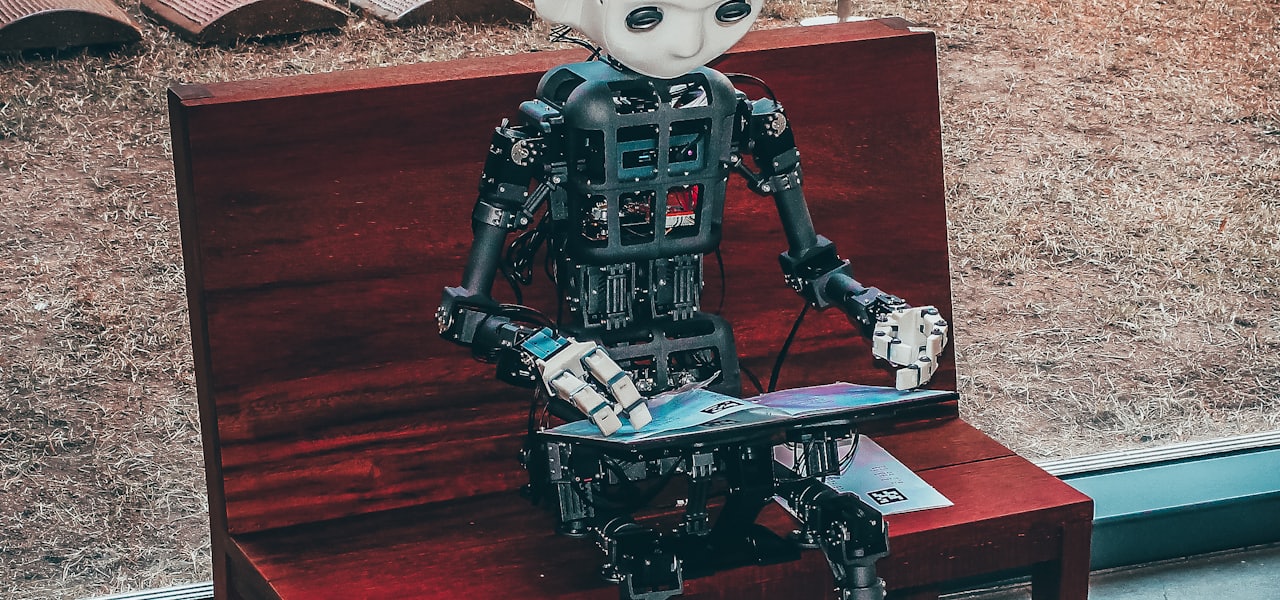
    The Frankenstein complex is a term coined by Isaac Asimov in his robot series, referring to the fear of mechanical men. == History == Some of Asimov's science fiction short stories and novels predict that this suspicion will become strongest and most widespread in respect of "mechanical men" that most-closely resemble human beings (see android), but it is also present on a lower level against robots that are plainly electromechanical automatons. The "Frankenstein complex" is similar in many respects to Masahiro Mori's uncanny valley hypothesis. The name, "Frankenstein complex", is derived from the name of Victor Frankenstein in the 1818 novel Frankenstein; or, The Modern Prometheus by Mary Shelley. In Shelley's story, Frankenstein created an intelligent, somewhat superhuman being, but he finds that his creation is horrifying to behold and abandons it. This ultimately leads to Victor's death at the conclusion of a vendetta between himself and his creation. In much of his fiction, Asimov depicts the general attitude of the public towards robots as negative, with ordinary people fearing that robots will either replace them or dominate them, although dominance would not be allowed under the specifications of the Three Laws of Robotics, the first of which is: "A robot may not harm a human being or, through inaction, allow a human being to come to harm." However, Asimov's fictitious earthly public is not fully persuaded by this, and remains largely suspicious and fearful of robots. I, Robot's short story "Little Lost Robot" is about this "fear of robots". In Asimov's robot novels, the Frankenstein complex is a major problem for roboticists and robot manufacturers. They do all they can to reassure the public that robots are harmless, even though this sometimes involves hiding the truth because they think that the public would misunderstand it. The fear by the public and the response of the manufacturers is an example of the theme of paternalism, the dread of paternalism, and the conflicts that arise from it in Asimov's fiction. The same theme occurs in many later works of fiction featuring robots, although it is rarely referred to as such.

    Read more →
  • Projection-slice theorem

    Projection-slice theorem

    In mathematics, the projection-slice theorem, central slice theorem or Fourier slice theorem in two dimensions states that the results of the following two calculations are equal: Take a two-dimensional function f(r), project (e.g. using the Radon transform) it onto a (one-dimensional) line, and do a Fourier transform of that projection. Take that same function, but do a two-dimensional Fourier transform first, and then slice the function through its origin, parallel to the projection line. In operator terms, if F1 and F2 are the 1- and 2-dimensional Fourier transform operators mentioned above, P1 is the projection operator (which projects a 2-D function onto a 1-D line), S1 is a slice operator (which extracts a 1-D central slice from a function), then F 1 P 1 = S 1 F 2 . {\displaystyle F_{1}P_{1}=S_{1}F_{2}.} This idea can be extended to higher dimensions. This theorem is used, for example, in the analysis of medical CT scans where a "projection" is an x-ray image of an internal organ. The Fourier transforms of these images are seen to be slices through the Fourier transform of the 3-dimensional density of the internal organ, and these slices can be interpolated to build up a complete Fourier transform of that density. The inverse Fourier transform is then used to recover the 3-dimensional density of the object. This technique was first derived by Ronald N. Bracewell in 1956 for a radio-astronomy problem. == The projection-slice theorem in N dimensions == In N dimensions, the projection-slice theorem states that the Fourier transform of the projection of an N-dimensional function f(r) onto an m-dimensional linear submanifold is equal to an m-dimensional slice of the N-dimensional Fourier transform of that function consisting of an m-dimensional linear submanifold through the origin in the Fourier space which is parallel to the projection submanifold. In operator terms: F m P m = S m F N . {\displaystyle F_{m}P_{m}=S_{m}F_{N}.\,} == The generalized Fourier-slice theorem == In addition to generalizing to N dimensions, the projection-slice theorem can be further generalized with an arbitrary change of basis. For convenience of notation, we consider the change of basis to be represented as B, an N-by-N invertible matrix operating on N-dimensional column vectors. Then the generalized Fourier-slice theorem can be stated as F m P m B = S m B − T | B − T | F N {\displaystyle F_{m}P_{m}B=S_{m}{\frac {B^{-T}}{|B^{-T}|}}F_{N}} where B − T = ( B − 1 ) T {\displaystyle B^{-T}=(B^{-1})^{T}} is the transpose of the inverse of the change of basis transform. == Proof in two dimensions == The projection-slice theorem is easily proven for the case of two dimensions. Without loss of generality, we can take the projection line to be the x-axis. There is no loss of generality because if we use a shifted and rotated line, the law still applies. Using a shifted line (in y) gives the same projection and therefore the same 1D Fourier transform results. The rotated function is the Fourier pair of the rotated Fourier transform, for which the theorem again holds. If f(x, y) is a two-dimensional function, then the projection of f(x, y) onto the x axis is p(x) where p ( x ) = ∫ − ∞ ∞ f ( x , y ) d y . {\displaystyle p(x)=\int _{-\infty }^{\infty }f(x,y)\,dy.} The Fourier transform of f ( x , y ) {\displaystyle f(x,y)} is F ( k x , k y ) = ∫ − ∞ ∞ ∫ − ∞ ∞ f ( x , y ) e − 2 π i ( x k x + y k y ) d x d y . {\displaystyle F(k_{x},k_{y})=\int _{-\infty }^{\infty }\int _{-\infty }^{\infty }f(x,y)\,e^{-2\pi i(xk_{x}+yk_{y})}\,dxdy.} The slice is then s ( k x ) {\displaystyle s(k_{x})} s ( k x ) = F ( k x , 0 ) = ∫ − ∞ ∞ ∫ − ∞ ∞ f ( x , y ) e − 2 π i x k x d x d y {\displaystyle s(k_{x})=F(k_{x},0)=\int _{-\infty }^{\infty }\int _{-\infty }^{\infty }f(x,y)\,e^{-2\pi ixk_{x}}\,dxdy} = ∫ − ∞ ∞ [ ∫ − ∞ ∞ f ( x , y ) d y ] e − 2 π i x k x d x {\displaystyle =\int _{-\infty }^{\infty }\left[\int _{-\infty }^{\infty }f(x,y)\,dy\right]\,e^{-2\pi ixk_{x}}dx} = ∫ − ∞ ∞ p ( x ) e − 2 π i x k x d x {\displaystyle =\int _{-\infty }^{\infty }p(x)\,e^{-2\pi ixk_{x}}dx} which is just the Fourier transform of p(x). The proof for higher dimensions is easily generalized from the above example. == The FHA cycle == If the two-dimensional function f(r) is circularly symmetric, it may be represented as f(r), where r = |r|. In this case the projection onto any projection line will be the Abel transform of f(r). The two-dimensional Fourier transform of f(r) will be a circularly symmetric function given by the zeroth-order Hankel transform of f(r), which will therefore also represent any slice through the origin. The projection-slice theorem then states that the Fourier transform of the projection equals the slice or F 1 A 1 = H , {\displaystyle F_{1}A_{1}=H,} where A1 represents the Abel-transform operator, projecting a two-dimensional circularly symmetric function onto a one-dimensional line, F1 represents the 1-D Fourier-transform operator, and H represents the zeroth-order Hankel-transform operator. == Extension to fan beam or cone-beam CT == The projection-slice theorem is suitable for CT image reconstruction with parallel beam projections. It does not directly apply to fanbeam or conebeam CT. The theorem was extended to fan-beam and conebeam CT image reconstruction by Shuang-ren Zhao in 1995.

    Read more →
  • Framebuffer

    Framebuffer

    A framebuffer (frame buffer, or sometimes framestore) is a portion of random-access memory (RAM) containing a bitmap that drives a video display. It is a memory buffer containing data representing all the pixels in a complete video frame. Modern video cards contain framebuffer circuitry in their cores. This circuitry converts an in-memory bitmap into a video signal that can be displayed on a computer monitor. In computing, a screen buffer is a part of computer memory used by a computer application for the representation of the content to be shown on the computer display. The screen buffer may also be called the video buffer, the regeneration buffer, or regen buffer for short. The phrase "screen buffer” refers to a logical function, while video memory refers to a hardware storage location. In particular, the screen buffer may be placed in the main RAM, the video memory, or some other hardware location. To reduce latency and avoid screen tearing, multiple frames can be buffered, and this technique is called multiple buffering. When this is so, at any time, only one frame would be visible, and the others would not be. The currently invisible frames are located in the off-screen buffer. The information in the buffer typically consists of color values for every pixel to be shown on the display. Color values are commonly stored in 1-bit binary (monochrome), 4-bit palettized, 8-bit palettized, 16-bit high color and 24-bit true color formats. An additional alpha channel is sometimes used to retain information about pixel transparency. The total amount of memory required for the framebuffer depends on the resolution of the output signal, and on the color depth or palette size. == History == Computer researchers had long discussed the theoretical advantages of a framebuffer but were unable to produce a machine with sufficient memory at an economically practicable cost. In 1947, the Manchester Baby computer used a Williams tube, later the Williams-Kilburn tube, to store 1024 bits on a cathode-ray tube (CRT) memory and displayed on a second CRT. Other research labs were exploring these techniques with MIT Lincoln Laboratory achieving a 4096 display in 1950. A color-scanned display was implemented in the late 1960s, called the Brookhaven RAster Display (BRAD), which used a drum memory and a television monitor. In 1969, A. Michael Noll of Bell Telephone Laboratories, Inc. implemented a scanned display with a frame buffer, using magnetic-core memory. A year or so later, the Bell Labs system was expanded to display an image with a color depth of three bits on a standard color TV monitor. The vector graphics used in the computer had to be converted for the scanned graphics of a TV display. In the early 1970s, the development of MOS memory (metal–oxide–semiconductor memory) integrated-circuit chips, particularly high-density DRAM (dynamic random-access memory) chips with at least 1 kb memory, made it practical to create, for the first time, a digital memory system with framebuffers capable of holding a standard video image. This led to the development of the SuperPaint system by Richard Shoup at Xerox PARC in 1972. Shoup was able to use the SuperPaint framebuffer to create an early digital video-capture system. By synchronizing the output signal to the input signal, Shoup was able to overwrite each pixel of data as it shifted in. Shoup also experimented with modifying the output signal using color tables. These color tables allowed the SuperPaint system to produce a wide variety of colors outside the range of the limited 8-bit data it contained. This scheme would later become commonplace in computer framebuffers. In 1974, Evans & Sutherland released the first commercial framebuffer, the Picture System, costing about $15,000. It was capable of producing resolutions of up to 512 by 512 pixels in 8-bit grayscale, and became a boon for graphics researchers who did not have the resources to build their own framebuffer. The New York Institute of Technology would later create the first 24-bit color system using three of the Evans & Sutherland framebuffers. Each framebuffer was connected to an RGB color output (one for red, one for green and one for blue), with a Digital Equipment Corporation PDP 11/04 minicomputer controlling the three devices as one. In 1975, the UK company Quantel produced the first commercial full-color broadcast framebuffer, the Quantel DFS 3000. It was first used in TV coverage of the 1976 Montreal Olympics to generate a picture-in-picture inset of the Olympic flaming torch while the rest of the picture featured the runner entering the stadium. The rapid improvement of integrated-circuit technology made it possible for many of the home computers of the late 1970s to contain low-color-depth framebuffers. Today, nearly all computers with graphical capabilities utilize a framebuffer for generating the video signal. Amiga computers, created in the 1980s, featured special design attention to graphics performance and included a unique Hold-And-Modify framebuffer capable of displaying 4096 colors. Framebuffers also became popular in high-end workstations and arcade system boards throughout the 1980s. SGI, Sun Microsystems, HP, DEC and IBM all released framebuffers for their workstation computers in this period. These framebuffers were usually of a much higher quality than could be found in most home computers, and were regularly used in television, printing, computer modeling and 3D graphics. Framebuffers were also used by Sega for its high-end arcade boards, which were also of a higher quality than on home computers. == Display modes == Framebuffers used in personal and home computing often had sets of defined modes under which the framebuffer can operate. These modes reconfigure the hardware to output different resolutions, color depths, memory layouts and refresh rate timings. In the world of Unix machines and operating systems, such conveniences were usually eschewed in favor of directly manipulating the hardware settings. This manipulation was far more flexible in that any resolution, color depth and refresh rate was attainable – limited only by the memory available to the framebuffer. An unfortunate side-effect of this method was that the display device could be driven beyond its capabilities. In some cases, this resulted in hardware damage to the display. More commonly, it simply produced garbled and unusable output. Modern CRT monitors fix this problem through the introduction of protection circuitry. When the display mode is changed, the monitor attempts to obtain a signal lock on the new refresh frequency. If the monitor is unable to obtain a signal lock or if the signal is outside the range of its design limitations, the monitor will ignore the framebuffer signal and possibly present the user with an error message. LCD monitors tend to contain similar protection circuitry, but for different reasons. Since the LCD must digitally sample the display signal (thereby emulating an electron beam), any signal that is out of range cannot be physically displayed on the monitor. == Color palette == Framebuffers have traditionally supported a wide variety of color modes. Due to the expense of memory, most early framebuffers used 1-bit (2 colors per pixel), 2-bit (4 colors), 4-bit (16 colors) or 8-bit (256 colors) color depths. The problem with such small color depths is that a full range of colors cannot be produced. The solution to this problem was indexed color, which adds a lookup table to the framebuffer. Each color stored in framebuffer memory acts as a color index. The lookup table serves as a palette with a limited number of different colors, while the rest is used as an index table. Here is a typical indexed 256-color image and its own palette (shown as a rectangle of swatches): In some designs, it was also possible to write data to the lookup table (or switch between existing palettes) on the fly, allowing dividing the picture into horizontal bars with their own palette and thus rendering an image that had a far wider palette. For example, viewing an outdoor shot photograph, the picture could be divided into four bars: the top one with emphasis on sky tones, the next with foliage tones, the next with skin and clothing tones, and the bottom one with ground colors. This required each palette to have overlapping colors, but, carefully done, allowed great flexibility. == Memory access == While framebuffers are commonly accessed via a memory mapping directly to the CPU memory space, this is not the only method by which they may be accessed. Framebuffers have varied widely in the methods used to access memory. Some of the most common are: Mapping the entire framebuffer to a given memory range. Port commands to set each pixel, range of pixels or palette entry. Mapping a memory range smaller than the framebuffer memory, then bank switching as necessary. The framebuffer organization may be packed pixel or planar. The framebuffer may be all

    Read more →
  • Transfer function matrix

    Transfer function matrix

    In control system theory, and various branches of engineering, a transfer function matrix, or just transfer matrix is a generalisation of the transfer functions of single-input single-output (SISO) systems to multiple-input and multiple-output (MIMO) systems. The matrix relates the outputs of the system to its inputs. It is a particularly useful construction for linear time-invariant (LTI) systems because it can be expressed in terms of the s-plane. In some systems, especially ones consisting entirely of passive components, it can be ambiguous which variables are inputs and which are outputs. In electrical engineering, a common scheme is to gather all the voltage variables on one side and all the current variables on the other regardless of which are inputs or outputs. This results in all the elements of the transfer matrix being in units of impedance. The concept of impedance (and hence impedance matrices) has been borrowed into other energy domains by analogy, especially mechanics and acoustics. Many control systems span several different energy domains. This requires transfer matrices with elements in mixed units. This is needed both to describe transducers that make connections between domains and to describe the system as a whole. If the matrix is to properly model energy flows in the system, compatible variables must be chosen to allow this. == General == A MIMO system with m outputs and n inputs is represented by a m × n matrix. Each entry in the matrix is in the form of a transfer function relating an output to an input. For example, for a three-input, two-output system, one might write, [ y 1 y 2 ] = [ g 11 g 12 g 13 g 21 g 22 g 23 ] [ u 1 u 2 u 3 ] {\displaystyle {\begin{bmatrix}y_{1}\\y_{2}\end{bmatrix}}={\begin{bmatrix}g_{11}&g_{12}&g_{13}\\g_{21}&g_{22}&g_{23}\end{bmatrix}}{\begin{bmatrix}u_{1}\\u_{2}\\u_{3}\end{bmatrix}}} where the un are the inputs, the ym are the outputs, and the gmn are the transfer functions. This may be written more succinctly in matrix operator notation as, Y = G U {\displaystyle \mathbf {Y} =\mathbf {G} \mathbf {U} } where Y is a column vector of the outputs, G is a matrix of the transfer functions, and U is a column vector of the inputs. In many cases, the system under consideration is a linear time-invariant (LTI) system. In such cases, it is convenient to express the transfer matrix in terms of the Laplace transform (in the case of continuous time variables) or the z-transform (in the case of discrete time variables) of the variables. This may be indicated by writing, for instance, Y ( s ) = G ( s ) U ( s ) {\displaystyle \mathbf {Y} (s)=\mathbf {G} (s)\mathbf {U} (s)} which indicates that the variables and matrix are in terms of s, the complex frequency variable of the s-plane arising from Laplace transforms, rather than time. The examples in this article are all assumed to be in this form, although that is not explicitly indicated for brevity. For discrete time systems s is replaced by z from the z-transform, but this makes no difference to subsequent analysis. The matrix is particularly useful when it is a proper rational matrix, that is, all its elements are proper rational functions. In this case, the state-space representation can be applied. In systems engineering, the overall system transfer matrix G (s) is decomposed into two parts: H (s) representing the system being controlled, and C(s) representing the control system. C (s) takes as its inputs the inputs of G (s) and the outputs of H (s). The outputs of C (s) form the inputs for H (s). == Electrical systems == In electrical systems, it is often the case that the distinction between input and output variables is ambiguous. They can be either, depending on circumstance and point of view. In such cases, the concept of port (a place where energy is transferred from one system to another) can be more useful than input and output. It is customary to define two variables for each port (p): the voltage across it (Vp) and the current entering it (Ip). For instance, the transfer matrix of a two-port network can be defined as follows, [ V 1 V 2 ] = [ z 11 z 12 z 21 z 22 ] [ I 1 I 2 ] {\displaystyle {\begin{bmatrix}V_{1}\\V_{2}\end{bmatrix}}={\begin{bmatrix}z_{11}&z_{12}\\z_{21}&z_{22}\\\end{bmatrix}}{\begin{bmatrix}I_{1}\\I_{2}\end{bmatrix}}} where the zmn are called the impedance parameters, or z-parameters. They are so-called because they are in units of impedance and relate port currents to a port voltage. The z-parameters are not the only way that transfer matrices are defined for two-port networks. Six basic matrices relate voltages and currents, each with advantages for particular system network topologies. However, only two of these can be extended beyond two ports to an arbitrary number of ports. These two are the z-parameters and their inverse, the admittance parameters or y-parameters. To understand the relationship between port voltages and currents and inputs and outputs, consider the simple voltage divider circuit. If we only wish to consider the output voltage (V2) resulting from applying the input voltage (V1) then the transfer function can be expressed as, [ V 2 ] = [ R 2 R 1 + R 2 ] [ V 1 ] {\displaystyle {\begin{bmatrix}V_{2}\end{bmatrix}}={\begin{bmatrix}{\dfrac {R_{2}}{R_{1}+R_{2}}}\end{bmatrix}}{\begin{bmatrix}V_{1}\end{bmatrix}}} which can be considered the trivial case of a 1×1 transfer matrix. The expression correctly predicts the output voltage if there is no current leaving port 2, but is increasingly inaccurate as the load increases. If, however, we attempt to use the circuit in reverse, driving it with a voltage at port 2 and calculate the resulting voltage at port 1 the expression gives completely the wrong result even with no load on port 1. It predicts a greater voltage at port 1 than was applied at port 2, an impossibility with a purely resistive circuit like this one. To correctly predict the behaviour of the circuit, the currents entering or leaving the ports must also be taken into account, which is what the transfer matrix does. The impedance matrix for the voltage divider circuit is, [ V 1 V 2 ] = [ R 1 + R 2 R 2 R 2 R 2 ] [ I 1 I 2 ] {\displaystyle {\begin{bmatrix}V_{1}\\V_{2}\end{bmatrix}}={\begin{bmatrix}R_{1}+R_{2}&R_{2}\\R_{2}&R_{2}\end{bmatrix}}{\begin{bmatrix}I_{1}\\I_{2}\end{bmatrix}}} which fully describes its behaviour under all input and output conditions. At microwave frequencies, none of the transfer matrices based on port voltages and currents are convenient to use in practice. Voltage is difficult to measure directly, current next to impossible, and the open circuits and short circuits required by the measurement technique cannot be achieved with any accuracy. For waveguide implementations, circuit voltage and current are entirely meaningless. Transfer matrices using different sorts of variables are used instead. These are the powers transmitted into, and reflected from a port, which are readily measured in the transmission line technology used in distributed-element circuits in the microwave band. The most well-known and widely used of these sorts of parameters is the scattering parameters, or s-parameters. == Mechanical and other systems == The concept of impedance can be extended into the mechanical and other domains through a mechanical-electrical analogy, hence the impedance parameters and other forms of 2-port network parameters can also be extended to the mechanical domain. To do this, an effort variable and a flow variable are made analogues of voltage and current, respectively. For mechanical systems under translation these variables are force and velocity respectively. Expressing the behaviour of a mechanical component as a two-port or multi-port with a transfer matrix is a useful thing to do because, like electrical circuits, the component can often be operated in reverse and its behaviour is dependent on the loads at the inputs and outputs. For instance, a gear train is often characterised simply by its gear ratio, a SISO transfer function. However, the gearbox output shaft can be driven around to turn the input shaft, requiring a MIMO analysis. In this example, the effort and flow variables are torque T and angular velocity ω, respectively. The transfer matrix in terms of z-parameters will look like, [ T 1 T 2 ] = [ z 11 z 12 z 21 z 22 ] [ ω 1 ω 2 ] {\displaystyle {\begin{bmatrix}T_{1}\\T_{2}\end{bmatrix}}={\begin{bmatrix}z_{11}&z_{12}\\z_{21}&z_{22}\end{bmatrix}}{\begin{bmatrix}\omega _{1}\\\omega _{2}\end{bmatrix}}} However, the z-parameters are not necessarily the most convenient for characterising gear trains. A gear train is the analogue of an electrical transformer and the h-parameters (hybrid parameters) better describe transformers because they directly include the turns ratios (the analogue of gear ratios). The gearbox transfer matrix in h-parameter format is, [ T 1 ω 2 ] = [ h 11 h 12 h 21 h 22 ] [ ω 1 T 2 ] {\displaystyle {\begin{bmatrix}T_{1}\\\omega _{2}\end{bm

    Read more →
  • Mixed raster content

    Mixed raster content

    Mixed raster content (MRC) is a method for compressing images that contain both binary-compressible text and continuous-tone components, using image segmentation methods to improve the level of compression and the quality of the rendered image. By separating the image into components with different compressibility characteristics, the most efficient and accurate compression algorithm for each component can be applied. MRC-compressed images are typically packaged into a hybrid file format such as DjVu and sometimes PDF. This allows for multiple images, and the instructions to properly render and reassemble them, to be stored within a single file. Some image scanners optionally support MRC when scanning to PDF. A typical manual states that without MRC, the image is generated in a single process, with text and graphics not distinguished. With MRC, separate processes are used for text, graphics, and other elements, producing clearer graphics and sharper text, at the price of slightly slower processing. MRC is recommended to optimise the scanning of documents with harder-to-read text or lower-quality graphics. MRC can also reduce the size of the scanned file, though higher compression using JBIG2 can sometimes lead to character substitution errors in scanned documents. == File format == A form of MRC is defined by international standard bodies as ISO/IEC 16485, or ITU recommendation T.44 (accessible free of charge). It defines a file format with bilevel masks and two data layers in each "stripe" of the image. The mask can be encoded in ITU T.4, JBIG1, or JBIG2, while the images can be JPEG, JBIG1, or run-length encoded color. The format is loosely based on JPEG, with a APP13 segment registered for this purpose. It is not known whether this file format is actually used, as formats like DjVu and PDF have their own ways of defining layers and masks.

    Read more →
  • Subvocal recognition

    Subvocal recognition

    Subvocal recognition (SVR) is the process of taking subvocalization and converting the detected results to a digital output, aural or text-based. A silent speech interface is a device that allows speech communication without using the sound made when people vocalize their speech sounds. It works by the computer identifying the phonemes that an individual pronounces from nonauditory sources of information about their speech movements. These are then used to recreate the speech using speech synthesis. == Input methods == Silent speech interface systems have been created using ultrasound and optical camera input of tongue and lip movements. Electromagnetic devices are another technique for tracking tongue and lip movements. The detection of speech movements by electromyography of speech articulator muscles and the larynx is another technique. Another source of information is the vocal tract resonance signals that get transmitted through bone conduction called non-audible murmurs. They have also been created as a brain–computer interface using brain activity in the motor cortex obtained from intracortical microelectrodes. == Uses == Such devices are created as aids to those unable to create the sound phonation needed for audible speech such as after laryngectomies. Another use is for communication when speech is masked by background noise or distorted by self-contained breathing apparatus. A further practical use is where a need exists for silent communication, such as when privacy is required in a public place, or hands-free data silent transmission is needed during a military or security operation. In 2002, the Japanese company NTT DoCoMo announced it had created a silent mobile phone using electromyography and imaging of lip movement. The company stated that "the spur to developing such a phone was ridding public places of noise," adding that, "the technology is also expected to help people who have permanently lost their voice." The feasibility of using silent speech interfaces for practical communication has since then been shown. In 2019, Arnav Kapur, a researcher from the Massachusetts Institute of Technology, conducted a study known as AlterEgo. Its implementation of the silent speech interface enables direct communication between the human brain and external devices through stimulation of the speech muscles. By leveraging neural signals associated with speech and language, the AlterEgo system deciphers the user's intended words and translates them into text or commands without the need for audible speech. == Research and patents == With a grant from the U.S. Army, research into synthetic telepathy using subvocalization is taking place at the University of California, Irvine under lead scientist Mike D'Zmura. NASA's Ames Research Laboratory in Mountain View, California, under the supervision of Charles Jorgensen is conducting subvocalization research. The Brain Computer Interface R&D program at Wadsworth Center under the New York State Department of Health has confirmed the existing ability to decipher consonants and vowels from imagined speech, which allows for brain-based communication using imagined speech, however using EEGs instead of subvocalization techniques. US Patents on silent communication technologies include: US Patent 6587729 "Apparatus for audibly communicating speech using the radio frequency hearing effect", US Patent 5159703 "Silent subliminal presentation system", US Patent 6011991 "Communication system and method including brain wave analysis and/or use of brain activity", US Patent 3951134 "Apparatus and method for remotely monitoring and altering brain waves". Latter two rely on brain wave analysis. == In fiction == The decoding of silent speech using a computer played an important role in Arthur C. Clarke's story and Stanley Kubrick's associated film A Space Odyssey. In this, HAL 9000, a computer controlling spaceship Discovery One, bound for Jupiter, discovers a plot to deactivate it by the mission astronauts Dave Bowman and Frank Poole through lip reading their conversations. In Orson Scott Card's series (including Ender's Game), the artificial intelligence can be spoken to while the protagonist wears a movement sensor in his jaw, enabling him to converse with the AI without making noise. He also wears an ear implant. In Speaker for the Dead and subsequent novels, author Orson Scott Card described an ear implant, called a "jewel", that allows subvocal communication with computer systems. Author Robert J. Sawyer made use of subvocal recognition to allow silent commands to the cybernetic 'companion implants' used by the advanced Neanderthal characters in his Neanderthal Parallax trilogy of science fiction novels. In Earth, David Brin depicts this technology and its uses as a normal gear in the near future. In Down and Out in the Magic Kingdom, Cory Doctorow has cellphone technology become silent through a cochlear implant and miking the throat to pick up subvocalization. William Gibson's Sprawl Trilogy frequently uses sub-vocalization systems in various devices. In Kage Baker's Company novels, the immortal cyborgs communicate subvocally. In the Hugo Award-winning Hyperion Cantos by Dan Simmons, the characters often use subvocalization to communicate. In the Culture novels by Iain M. Banks, more highly advanced species often communicate subvocally through their technology. In Deus Ex: Human Revolution (2011), the protagonist is augmented with a subvocalization implant for sending covert communications (and a corresponding cochlear implant for receiving covert communications). In the tabletop RPG and video game series Shadowrun, player characters can communicate via subvocal microphones in some instances. In Paranoia, all citizens can speak to the computer via their "cerebral cortech" implants. Alistair Reynolds Revelation Space trilogy frequently uses sub-vocalization systems in various devices.

    Read more →
  • Automaton

    Automaton

    An automaton ( ; pl.: automata or automatons) is a relatively self-operating machine or control mechanism designed to automatically follow a sequence of operations or respond to predetermined instructions. Some automata, such as bellstrikers in mechanical clocks, are designed to give the illusion to the casual observer that they are operating under their own power or will, like a mechanical robot. The term has long been commonly associated with automated puppets that resemble moving humans or animals, built to impress and/or to entertain people. Animatronics are a modern type of automata with electronics, often used for the portrayal of characters or creatures in films and in theme park attractions. == Etymology == The word automaton is the latinization of the Ancient Greek automaton (αὐτόματον), which means "acting of one's own will". It was first used by Homer to describe an automatic door opening, or automatic movement of wheeled tripods. It is more often used to describe non-electronic moving machines, especially those that have been made to resemble human or animal actions, such as the jacks on old public striking clocks, or the cuckoo and any other animated figures on a cuckoo clock. == History == === Ancient === There are many examples of automata in Greek mythology: Hephaestus created automata for his workshop; Talos was an artificial man of bronze; King Alkinous of the Phaiakians employed gold and silver watchdogs. According to Aristotle, Daedalus used quicksilver to make his wooden statue of Aphrodite move. In other Greek legends he used quicksilver to install voice in his moving statues. The automata in the Hellenistic world were intended as tools, toys, religious spectacles, or prototypes for demonstrating basic scientific principles. Numerous water-powered automata were built by Ktesibios, a Greek inventor and the first head of the Great Library of Alexandria; for example, he "used water to sound a whistle and make a model owl move. He had invented the world's first 'cuckoo clock'". This tradition continued in Alexandria with inventors such as the Greek mathematician Hero of Alexandria (sometimes known as Heron), whose writings on hydraulics, pneumatics, and mechanics described siphons, a fire engine, a water organ, the aeolipile, and a programmable cart. Philo of Byzantium was famous for his inventions. Complex mechanical devices are known to have existed in Hellenistic Greece, though the only surviving example is the Antikythera mechanism, the earliest known analog computer. The clockwork is thought to have come originally from Rhodes, where there was apparently a tradition of mechanical engineering; the island was renowned for its automata; to quote Pindar's seventh Olympic Ode: The animated figures stand Adorning every public street And seem to breathe in stone, or move their marble feet. However, the information gleaned from recent scans of the fragments indicate that it may have come from the colonies of Corinth in Sicily and implies a connection with Archimedes. According to Jewish legend, King Solomon used his wisdom to design a throne with mechanical animals which hailed him as king when he ascended it; upon sitting down an eagle would place a crown upon his head, and a dove would bring him a Torah scroll. It is also said that when King Solomon stepped upon the throne, a mechanism was set in motion. As soon as he stepped upon the first step, a golden ox and a golden lion each stretched out one foot to support him and help him rise to the next step. On each side, the animals helped the King up until he was comfortably seated upon the throne. In ancient China, a curious account of automata is found in the Lie Zi text, believed to have originated around 400 BCE and compiled around the fourth century CE. Within it there is a description of a much earlier encounter between King Mu of Zhou (1023–957 BCE) and a mechanical engineer known as Yan Shi, an 'artificer'. The latter proudly presented the king with a very realistic and detailed life-size, human-shaped figure of his mechanical handiwork: The king stared at the figure in astonishment. It walked with rapid strides, moving its head up and down, so that anyone would have taken it for a live human being. The artificer touched its chin, and it began singing, perfectly in tune. He touched its hand, and it began posturing, keeping perfect time...As the performance was drawing to an end, the robot winked its eye and made advances to the ladies in attendance, whereupon the king became incensed and would have had Yen Shih [Yan Shi] executed on the spot had not the latter, in mortal fear, instantly taken the robot to pieces to let him see what it really was. And, indeed, it turned out to be only a construction of leather, wood, glue and lacquer, variously coloured white, black, red and blue. Examining it closely, the king found all the internal organs complete—liver, gall, heart, lungs, spleen, kidneys, stomach and intestines; and over these again, muscles, bones and limbs with their joints, skin, teeth and hair, all of them artificial...The king tried the effect of taking away the heart, and found that the mouth could no longer speak; he took away the liver and the eyes could no longer see; he took away the kidneys and the legs lost their power of locomotion. The king was delighted. Other notable examples of automata include Archytas' dove, mentioned by Aulus Gellius. Similar Chinese accounts of flying automata are written of the 5th century BC Mohist philosopher Mozi and his contemporary Lu Ban, who made artificial wooden birds (ma yuan) that could successfully fly according to the Han Fei Zi and other texts. === Medieval === The manufacturing tradition of automata continued in the Greek world well into the Middle Ages. On his visit to Constantinople in 949 ambassador Liutprand of Cremona described automata in the emperor Theophilos' palace, including "lions, made either of bronze or wood covered with gold, which struck the ground with their tails and roared with open mouth and quivering tongue," "a tree of gilded bronze, its branches filled with birds, likewise made of bronze gilded over, and these emitted cries appropriate to their species" and "the emperor's throne" itself, which "was made in such a cunning manner that at one moment it was down on the ground, while at another it rose higher and was to be seen up in the air." Similar automata in the throne room (singing birds, roaring and moving lions) were described by Luitprand's contemporary the Byzantine emperor Constantine Porphyrogenitus, in his book De Ceremoniis (Perì tês Basileíou Tákseōs). In the mid-8th century, the first wind powered automata were built: "statues that turned with the wind over the domes of the four gates and the palace complex of the Round City of Baghdad". The "public spectacle of wind-powered statues had its private counterpart in the 'Abbasid palaces where automata of various types were predominantly displayed." Also in the 8th century, the Muslim alchemist, Jābir ibn Hayyān (Geber), included recipes for constructing artificial snakes, scorpions, and humans that would be subject to their creator's control in his coded Book of Stones. In 827, Abbasid caliph al-Ma'mun had a silver and golden tree in his palace in Baghdad, which had the features of an automatic machine. There were metal birds that sang automatically on the swinging branches of this tree built by Muslim inventors and engineers. The Abbasid caliph al-Muqtadir also had a silver and golden tree in his palace in Baghdad in 917, with birds on it flapping their wings and singing. In the 9th century, the Banū Mūsā brothers invented a programmable automatic flute player and which they described in their Book of Ingenious Devices. Al-Jazari described complex programmable humanoid automata amongst other machines he designed and constructed in the Book of Knowledge of Ingenious Mechanical Devices in 1206. His automaton was a boat with four automatic musicians that floated on a lake to entertain guests at royal drinking parties. His mechanism had a programmable drum machine with pegs (cams) that bump into little levers that operate the percussion. The drummer could be made to play different rhythms and drum patterns if the pegs were moved around. Al-Jazari constructed a hand washing automaton first employing the flush mechanism now used in modern toilets. It features a female automaton standing by a basin filled with water. When the user pulls the lever, the water drains and the automaton refills the basin. His "peacock fountain" was another more sophisticated hand washing device featuring humanoid automata as servants who offer soap and towels. Mark E. Rosheim describes it as follows: "Pulling a plug on the peacock's tail releases water out of the beak; as the dirty water from the basin fills the hollow base a float rises and actuates a linkage which makes a servant figure appear from behind a door under the peacock and offer soap.

    Read more →
  • Moving object detection

    Moving object detection

    Moving object detection is a technique used in computer vision and image processing. Multiple consecutive frames from a video are compared by various methods to determine if any moving object is detected. Moving objects detection has been used for wide range of applications like video surveillance, activity recognition, road condition monitoring, airport safety, monitoring of protection along marine border, etc. == Definition == Moving object detection is to recognize the physical movement of an object in a given place or region. By acting segmentation among moving objects and stationary area or region, the moving objects' motion can be tracked and thus analyzed later. To achieve this, consider a video is a structure built upon single frames, moving object detection is to find the foreground moving target(s), either in each video frame or only when the moving target shows the first appearance in the video. == Traditional methods == Among all the traditional moving object detection methods, we could categorize them into four major approaches: Background subtraction, Frame differencing, Temporal Differencing, and Optical Flow. === Frame differencing === Instead of using traditional approach, to use image subtraction operator by subtracting second and images afterwards, the frame differencing method makes comparisons between two successive frames to detect moving targets. === Temporal differencing === The temporal differencing method identifies the moving object by applying pixel-wise difference method with two or three consecutive frames.

    Read more →
  • Visible (mobile app)

    Visible (mobile app)

    Visible is a health tracking mobile app for people with long COVID and myalgic encephalomyelitis/chronic fatigue syndrome (ME/CFS). The company was founded by a Harry Leeming, an engineer from London living with long Covid since 2020, and Luke Martin-Fuller. In November 2022, Visible released an open beta of an app that aims to help people pace their activities to avoid post-exertional malaise. The app gathers data on exertion levels, symptom severity, and heart-rate variability. HRV is approximated using a smartphone's camera via a technique called photoplethysmography, and according to the app's developers, can indicate how much someone needs rest. The app is currently free, but is expected to be freemium in the future. Users can also opt to allow their data be used for research purposes. In July 2023, Visible and Imperial College London announced the start of the first two studies. One is on the effects of the menstrual cycle on long COVID symptoms, and the other is on the condition's epidemiology and economic impact. Visible has announced plans to couple the app with activity trackers for continuous monitoring of heart-rate and actimetry data, which the developers claim will be more effective. As of 2022, no clinical trials on Visible's effectiveness have been conducted.

    Read more →
  • Non-native speech database

    Non-native speech database

    A non-native speech database is a speech database of non-native pronunciations of English. Such databases are used in the development of: multilingual automatic speech recognition systems, text to speech systems, pronunciation trainers, and second language learning systems. == List == The actual table with information about the different databases is shown in Table 2. === Legend === In the table of non-native databases some abbreviations for language names are used. They are listed in Table 1. Table 2 gives the following information about each corpus: The name of the corpus, the institution where the corpus can be obtained, or at least further information should be available, the language which was actually spoken by the speakers, the number of speakers, the native language of the speakers, the total amount of non-native utterances the corpus contains, the duration in hours of the non-native part, the date of the first public reference to this corpus, some free text highlighting special aspects of this database and a reference to another publication. The reference in the last field is in most cases to the paper which is especially devoted to describe this corpus by the original collectors. In some cases it was not possible to identify such a paper. In these cases a paper is referenced which is using this corpus is. Some entries are left blank and others are marked with unknown. The difference here is that blank entries refer to attributes where the value is just not known. Unknown entries, however, indicate that no information about this attribute is available in the database itself. As an example, in the Jupiter weather database no information about the origin of the speakers is given. Therefore this data would be less useful for verifying accent detection or similar issues. Where possible, the name is a standard name of the corpus, for some of the smaller corpora, however, there was no established name and hence an identifier had to be created. In such cases, a combination of the institution and the collector of the database is used. In the case where the databases contain native and non-native speech, only attributes of the non-native part of the corpus are listed. Most of the corpora are collections of read speech. If the corpus instead consists either partly or completely of spontaneous utterances, this is mentioned in the Specials column.

    Read more →
  • Gapo

    Gapo

    Gapo is a Vietnamese social networking service based in Hanoi, Vietnam. Users are able to create a personal profile and share text, photos and videos with others on the platform. Users can also use Gapo for live streaming, instant messaging, blogging, and online payments. Gapo was launched in July 2019 by Hà Trung Kiên and Duong Vi Khoa. == History == Gapo was founded in response to calls for Vietnam's Communist-led government to produce a domestic alternative to social media giants like Facebook and Google. Gapo officially launched on July 23, 2019 at an event in Hanoi. The company received 500 billion đồng (US$22 million) in funding from technology corporation G-Group to be utilized in the first phase of development. They also partnered with Sony Music Entertainment to provide music content to its services. == Features == Gapo features a news feed for posting content, livestreaming, instant messaging, and blogging. It also allows users to pay online and access public services. == Reception == Within two days of launch, Gapo received about 200,000 registrations. By September 2019, the user base increased to one million. Upon launch, Gapo experienced significant technical difficulties. Users complained about the inability to sign up for a new account and said that certain functions were not available for use at launch. This issue caused Gapo to temporarily suspend their services in order to perform upgrades and bug fixes. Gapo relaunched the next day, though many users reported that the access speed decreased. The mobile app also received mixed reviews from users in both the App Store and the Google Play Store, with an average rating of 3.1 and 3.5, respectively. Most users found the app to be a knockoff of Facebook, although some users praised the app for being locally developed. === Expert opinions on platform viability === Le Hong Hiep of the ISEAS - Yusof Ishak Institute was doubtful that a Vietnamese-owned social network service could be as powerful as a foreign-based service, stating that Vietnam might not be able to develop a viable social media network to compete with the likes of Facebook or Google. Others, like blogger Ann Chi, said that, due to local players complying with local censorship policy, there is a chance that locals might not trust Gapo and other local services in light of possible surveillance. Regarding the targeted user base figure for the end of 2019 and 2021, experts cautioned that the company might need an additional trillion đồng of funding to reach its planned user base targets. In response, the company stated that Gapo was never meant to compete with Facebook, but instead noted that the main difference between Gapo and Facebook is that Gapo provides a personalized user experience through customization. == Censorship == Gapo has the right to censor posts and news that are deemed offensive and inaccurate by users or not approved by the censorship curators.

    Read more →